How To Help Your Partner With OCD Without Losing Yourself

What To Do When The Person You Love Is Caught In A Loop, And You Are Caught In It With Them
You have answered the question. You have answered it kindly, and then you have answered it again, and by the fourth time your voice has an edge in it that you did not put there on purpose.
Then comes the guilt, which is somehow worse than the tiredness.
If you are the husband, the wife, the partner, the one who loves someone with OCD, this is written for you. Not for them. You matter in this too, and most of what gets written about OCD quietly assumes you are a passive bystander.
You Are Allowed To Be Tired
Here is the thing almost nobody says to the partner of someone with OCD: your frustration makes sense.
You are watching someone you love do something that looks, from the outside, entirely optional. You can see the door is locked. You can see their hands are clean. You know the answer to the question because you have given it eleven times. The gap between what you can see and what they can feel is maddening, and pretending otherwise helps no one.
Dr. Sunil Nandlal Punjabi, who spent twenty years as his wife's partner through her OCD before becoming an OCD counsellor himself, draws a line I have not heard put more cleanly. Your resentment, he says, is understandable, even when it is not valid.
Both halves of that matter. Understandable, because you are a person with finite patience living inside something exhausting. Not valid, because the person beside you is not choosing this, is not doing it at you, and is very likely more frightened of it than you are.
You can hold both. Most partners who do well eventually do.
What Is Actually Happening To Them
OCD runs on a loop with two parts.
An obsession is an unwanted or intrusive thought, image, perceived urge, or physical sensation that shows up uninvited and lands as threatening. It is not a wish. It is not a plan. It is closer to a smoke alarm going off because you made toast or blew out a match stick.
A compulsion is whatever they do to try to make that alarm stop. Washing. Checking. Counting. Confessing. Mentally reviewing an event for the ninth time. And very often, asking you for reassurance.
Here is the cruel part. The compulsion works, briefly. The anxiety drops. And because it drops, the brain files the compulsion as the thing that keeps them safe, which makes the next alarm louder and the next compulsion more necessary.
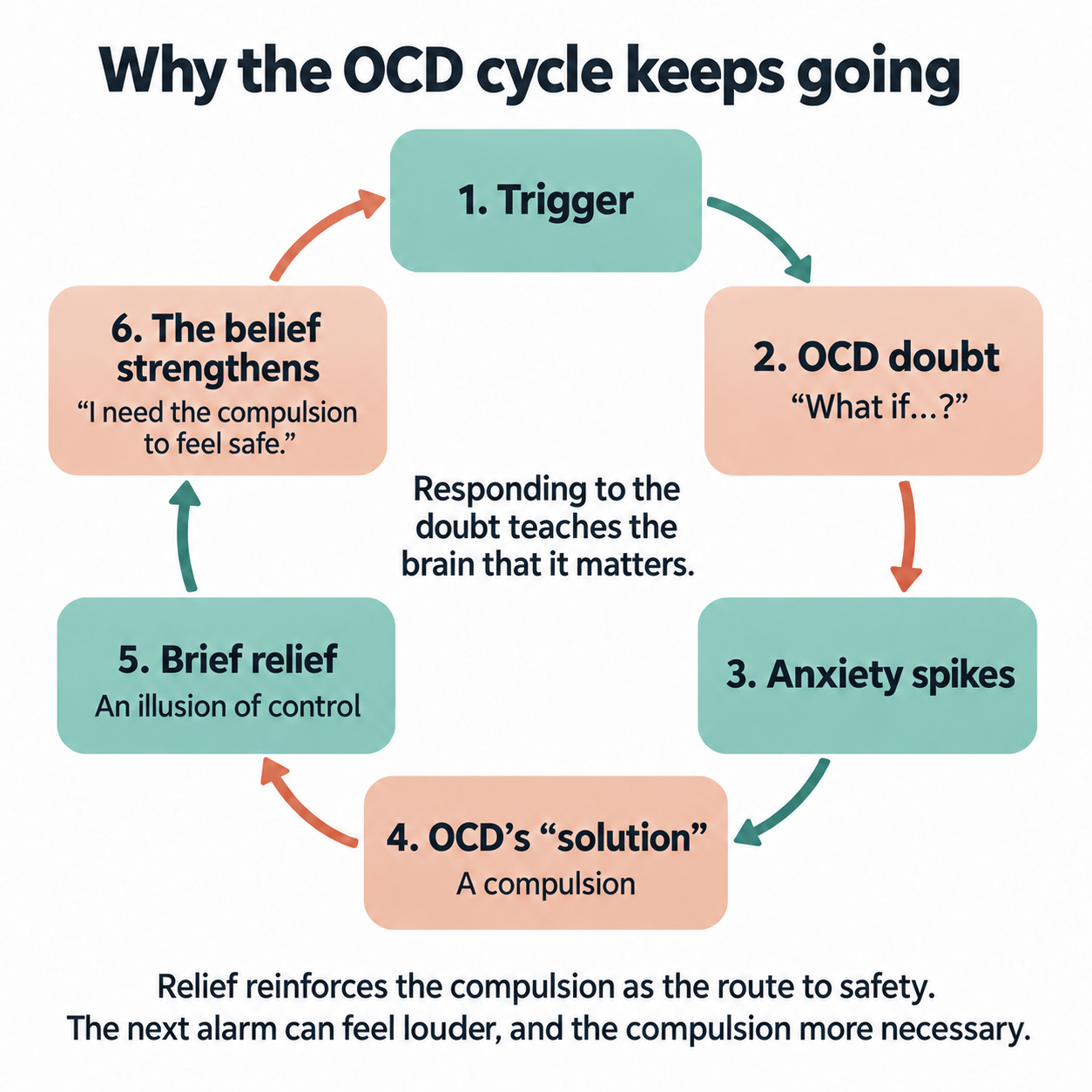
So when you answer the question, you are being kind to your partner, but you are feeding OCD. You did not know that, and nobody told you, and it is the most natural thing in the world to have done. Most of the time the person with OCD doesn’t even know that their reassurance seeking is a compulsion and that it is actually harming them. It is so counterintuitive. When you care about them you do not want to see them suffer and if answering a question would stop the suffering, why wouldn’t a partner do that? Well, this is why.
Family Accommodation: The Trap With A Kind Name
Clinicians have a term for the things loved ones do to reduce a person's distress in the moment: family accommodation. It is one of the most common features of OCD in a household, and it is almost invisible from the inside, because every single piece of it looks like love.
You may recognize some of these:
- Answering the same reassurance question, in slightly different words, again and again
- Checking the stove, the lock, or the email so they do not have to
- Washing your hands or changing your clothes to their standard
- Taking over a task they have become unable to do
- Avoiding a restaurant, a route, a topic, or a person because it sets them off
- Giving a "no, of course you didn't" that you have given a hundred times
- Waiting. Just waiting, while a ritual finishes, for the third time this evening
None of that makes you a bad partner. It makes you a responsive and kind one. The problem is that OCD is very good at recruiting and begging.
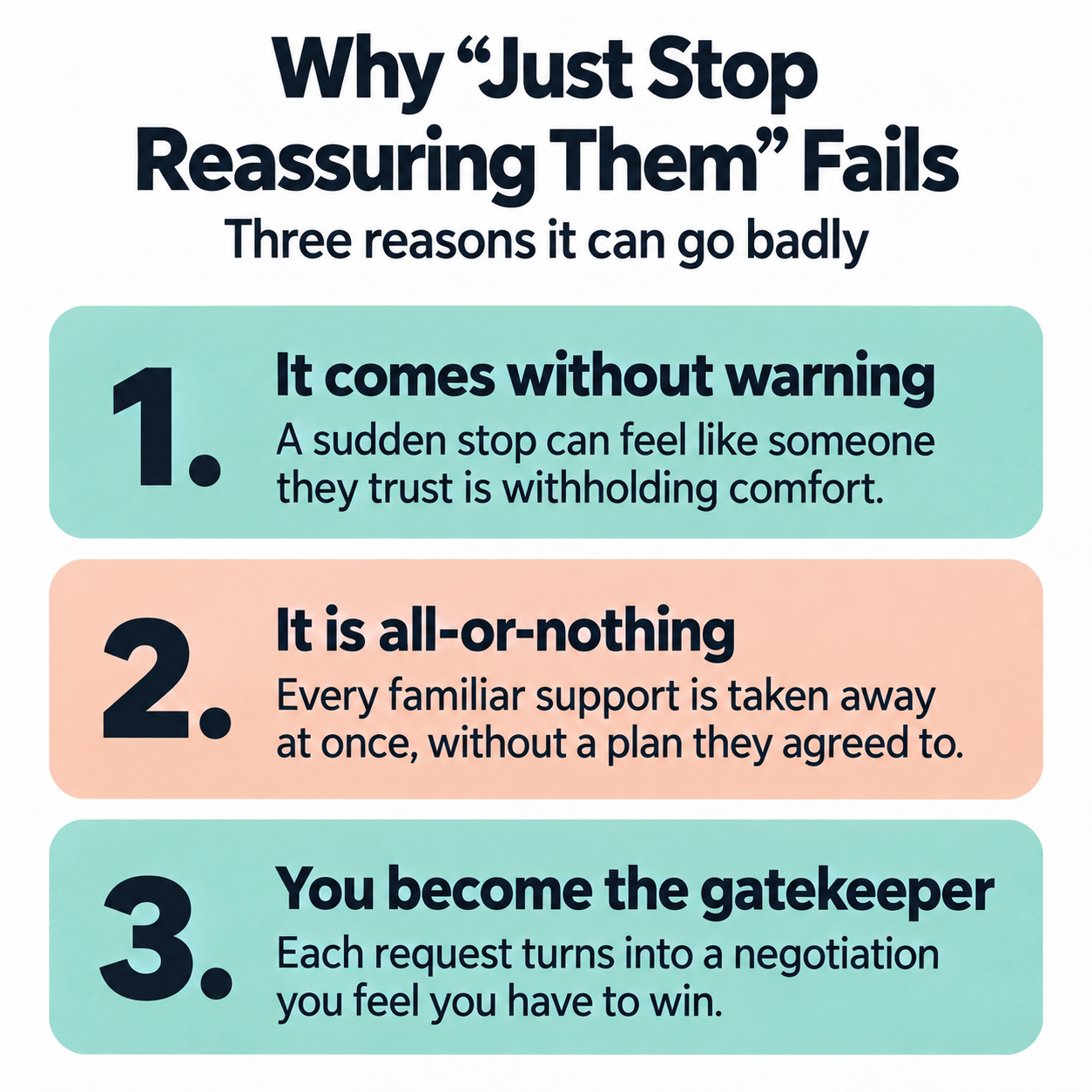
Why "Just Stop Reassuring Them" Fails
This is usually the point where someone hands you the advice to stop accommodating, and you try it, feel awful about it, and it goes badly. You think, “I thought this was what I was supposed to do and it would help?”
It goes badly for three reasons.
- Withholding accommodations or reassurance arrives without warning. From their side it does not feel like treatment, it feels like the person they love and trust is suddenly withholding comfort.
- It is all-or-nothing. This approach asks someone to give up every crutch on any random day for reasons they did not agree to.
- It puts you in the role of gatekeeper, which means every interaction becomes a negotiation you have to win.
Reducing accommodation is genuinely one of the most useful things everyone in their life can do. But it works when it is planned, gradual, and agreed to in advance, by both of you, when nobody is in the middle of a spike.
Five Steps That Actually Work
Step One: Have the conversation when things are calm.
Not at 11pm in the middle of a reassurance cycle. Pick a calm time of day, perhaps a weekend morning. The goal of that first conversation is not a plan, it is a shared name for the problem: this thing is OCD, it is not you, and we are going to be on the same side of it.
Step Two: Pick one accommodation. One.
Ask them which one they think they could loosen first. Let them choose, because the choosing is itself a piece of treatment. If they cannot choose, pick the smallest one you can find, not the one that annoys you most.
Everything else stays for now. That is not failure, that is sequencing.
Step Three: Make a reassurance agreement.
Together, look at roughly how many times a day reassurance is being asked for. Do not guess, get some real data. Based on that number, you agree on how many reassurances can be given daily to start. I suggest starting at the number you counted and maybe add a couple. For example, if your loved one is asking “is this clean?” 10 times a day, you may agree to start with 12 reassurances allowed on day one.
Some couples find it helps to think of them as coupons or tickets. There is a set number for the day, and the person with OCD gets to decide how to spend them. That last part is what makes this work. It moves the decision from you to them, which is where treatment has to live anyway. I have found with my clients that this small behavioral change of stopping to consider if they can delay seeking the reassurance in order to reserve the tickets for later in the day if things get worse is the strategy that starts to unhook OCD. They start to choose to not ask for reassurance in time where they are resourced enough to move forward without it. This is exactly what starves the OCD. Then over the course of several days, the number per day will decline by 1. You both agree on what rate to decline the number of reassurances.
Step Four: Learn to praise the microscopic.
This is the step partners skip, and it is the one that decides whether any of this survives past week two.
Dr. Punjabi puts it this way, “Treat your partner like an intelligent child, not a dumb adult. When a small child tells you two plus two is four, you do not say "everybody knows that, now do twenty-five times seventy-five." You meet them where they are and you can give them some words of affirmation and encouragement. Notice they are doing the hard work.
So when a ten minute handwash becomes a nine minute handwash, that is not "well, it's a start." That minute cost them more than you can see from outside the bathroom door. Let them know you are seeing their effort. The next minute gets easier when the last one is noticed.
“Let them know you are seeing their effort. The next minute gets easier when the last one is noticed.”
Step Five: Start to live a fuller life, not just shrink the OCD.
Think of a glass filled with water. The water represents OCD. OCD will take every inch of space you give it, and then ask for more. You can try to bail the water out, which is exhausting and slow. Or you can start dropping in pebbles: a hobby they dropped, a friend they stopped calling, a walk, a class, a Saturday that belongs to something else.
Dr. Punjabi uses a wardrobe analogy for the same idea. If you want room for new clothes, the old ones have to come out first.
So notice the ordinary things too. If they are still washing, checking, ruminating… but they also answered an email they had been avoiding or cooked food they were avoiding cooking, that counts. Any minute reclaimed for an ordinary life is a minute taken back from OCD.
“Any minute reclaimed for an ordinary life is a minute taken back from OCD.”
What To Say Instead Of Reassurance
You do not have to choose between lying and stonewalling. There is a middle, and it sounds like this.
- "I think that's what the OCD is asking. Do you want to use one of today's coupons, or sit with it?"
- "I love you, and I'm not going to answer that one."
- "I don't know for certain. Neither of us does. Want to do the next thing anyway?"
- "That sounds really uncomfortable. I'm here."
- "You already know what I'd say. What would you rather do with this?"
Notice what these have in common. They stay warm. They decline the content of the question without declining the person. And several of them hand the decision back.
Taking Care Of You Is Not Optional
Partner burnout is real, and it is quiet, and it usually gets noticed only after something breaks.
Dr. Punjabi did not notice his. He spent years carrying the household, the job, and his son's schooling while his wife was in treatment, and was eventually diagnosed with depression himself. Looking back, he describes the story he had been living in: that he was carrying the weight, all of it, all of the time, and his wife was not doing enough. A therapist named it “being a victim.” He did not like hearing it. He refused to be a victim or a hero.
Watch for the signs in yourself:
- Dread on the drive home
- Keeping score
- Talking about your partner in a tone you would not want them to hear
- A social life that has quietly gone to nothing
- Snapping at your partner
- Giving up your hobbies
What helps is smaller than you think. Keep something for yourself, and do not hold it against yourself when you take it. A movie with your feet up. Lunch with a friend. A morning that is not about anyone's anxiety.
You will have to cut some things back. You do not have to cut them to zero. A depleted partner is not a more helpful one, and running yourself down does not help anyone.
When To Get Help, And What Kind
If setting up a plan to reduce reassurance seeking and accommodations feels overwhelming, if you are confused on where to start, or if the two of you cannot have this conversation without it turning into a fight, that is a sign to bring in a skilled OCD specialist, not a sign that you failed.
Two things are worth knowing before you book anyone.
A therapist who says they treat anxiety does not necessarily treat OCD. Exposure and response prevention (ERP) is a specific approach with specific mechanics, and general talk therapy can leave OCD untouched or make it worse by giving it a fresh audience to explain its fears to and gain the wanted reassurance and validation it craves. It is worth asking direct questions before the first session. I wrote a guide to exactly which questions in Your Therapist Said They Treat OCD. But Do They Really?, and on why the answer "I use CBT" is not enough.
The same is true of couples counseling. A skilled couples therapist who does not understand OCD can accidentally coach you into more accommodation, or treat a compulsion as a communication problem. Ask them directly whether they have worked with OCD before. In my work with clients, I speak to the significant person alongside my client for a few sessions. Here I provide OCD 101 psychoeducation and have them decide on the plan as a team with me there to guide and coach them along the way. It has proven to be very effective over the years.
And if you want to understand what the treatment actually asks of your partner, Beyond White-Knuckling: Why Mindset Matters in ERP Therapy is the honest version of why starting ERP is easier than sustaining it.
A Practice For The Partner
Most of this article asks you to do something differently. This part asks you to do nothing at all, which is often harder.
This part asks you to do nothing at all, which is often harder.
There is a particular skill in staying settled while someone you love is not settled. Not fixing it. Not fleeing it. Just being a steady presence in the room while the wave passes, which it will, because waves do. They come and go.
You Are Not The Villain Here
If you have been accommodating for years, you have not been sabotaging anyone. You have been loving someone the only way the situation seemed to allow, without a map, and mostly alone.
The work ahead is not about becoming stricter. It is about becoming a teammate instead of a supplier. You stop handing over the temporary relief and start standing next to them for the uncomfortable part, which is where the actual getting-better happens.
It will be slow. It will not be linear. Dr. Punjabi's marriage nearly ended in the middle of it, and he describes it now as stronger than it has ever been, with his wife most of the way through her recovery and their son grown.
Go gently. You are doing something hard, and you are doing it for someone you love.
Listen To The Full Conversation
Dr. Punjabi told his whole story on the podcast, including the parts most people leave out: the four months he and his wife lived apart, his own depression, and the sentence a therapist said that changed how he saw himself in his own marriage.
[Living With A Spouse Who Has OCD: Twenty Years, Two Ants, And The Long Road Back]
Work With Me
If you are carrying this at home and you would like some help carrying it, I work with individuals and couples navigating OCD, including partners who are not the ones with the diagnosis. You are allowed to get support for your own sake, not only as a means of helping someone else.
Disclaimer: This article is for informational and educational purposes only and is not a substitute for therapy, clinical diagnosis, or professional mental health treatment. If you are struggling, please seek support from a qualified mental health professional.
© OCD Insights™
Most People Don't Recognize OCD Because It Doesn't Look Like OCD.
You're Not Alone and You're Not Broken.
From contamination fears to relationship doubt, harm obsessions to religious guilt- OCD shows up in ways most people never expect. This free guide breaks down every major theme so you can finally put a name to what your mind has been doing.